
A two-way radio is a portable device that lets users send and receive voice communications without relying on a mobile phone network or internet connection.
Whether you have seen them used by the police or at a festival, two-way radios are one of the most widely used communication tools used by UK industries.
This guide explains how they work, what types are available, and when they are the right choice.
How Does a Two-Way Radio Work?
Two-way radios convert speech into radio waves, they then transmit those waves through the air, and convert them back to audio when they are received by another radio on the same channel.
Unlike a phone call, one person speaks at a time, pressing a push-to-talk button to transmit. This makes communication faster and more disciplined in operational settings, where brief, clear messages are more effective than open phone lines.
Radios operate across two main frequency bands. The first travels well over open terrain and is commonly used outdoors. The second penetrates buildings and dense structures more effectively and is the preferred choice for indoor and urban environments.
Analogue vs Digital: What Is the Difference?
Analogue radios transmit voice as a continuous signal. They are straightforward, widely compatible, and reliable. Digital radios convert voice into a data stream before transmission. The result is clearer audio, better range at the edges of coverage, and the ability to carry additional information such as text messages, GPS location data, and status alerts.
Digital radios also support encryption, which prevents unauthorised users from accessing a channel.
- Read more about Analogue vs Digital Two-Way Radios
Two-Way Radio vs Walkie-Talkie: Is There a Difference?
The term “walkie-talkie” is commonly used for compact, licence-free consumer radios, such as those used for outdoor recreation or children’s play. The term “two-way radio” covers the broader category, including both licence-free consumer devices and the licensed professional equipment used across industry, events, and public safety.
Licence-free radios do not require an Ofcom licence and are ready to use out of the box. They are limited in range, typically covering a few hundred metres in built-up areas, and all licence-free radios share the same public channels.
For business use, licensed radios on dedicated channels offer greater range, privacy, and capacity.
Do You Need a Licence to Use a Two-Way Radio in the UK?
It depends on the type of radio. Licence-free radios require no licence. For all other professional and commercial radio equipment, an Ofcom licence is required. Licences allocate specific channels to your organisation, which means other users cannot access your communications.
Ofcom issues different licence types depending on the scale and location of your operation. Operating a licensed radio without the correct authorisation is a legal offence.
What Types of Two-Way Radio Are Available?
The professional radio market covers a wide range of device types, each designed for a specific environment or use case.
- Analogue radios are suited to straightforward operations where simplicity and low cost are priorities.
- Digital radios offer clearer audio, encryption, and data features. They range from compact entry-level handsets through to rugged, feature-rich models used in demanding environments.
- ATEX radios are certified for use in hazardous environments where flammable gases or dust are present, including petrochemical sites, mines, and distilleries. See ATEX Two-way Radios Explained
- LTE/4G radios combine traditional push-to-talk functionality with mobile network coverage, making them suitable for wide-area or multi-site operations.
- Licence-free radios require no Ofcom authorisation and are ready to use out of the box, making them suitable for low-range, low-security applications.
- Marine radios are built to international safety standards for use on commercial and recreational vessels.
Where Are Two-Way Radios Used?
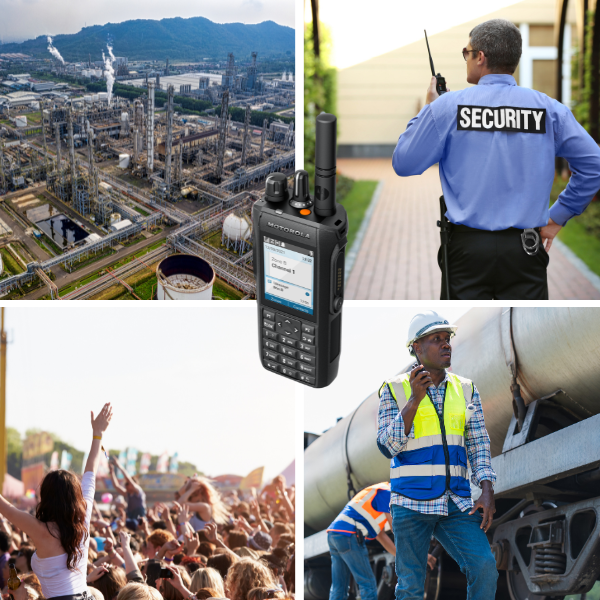
Two-way radios are deployed across virtually every sector that involves coordinating teams across a site. Common applications include:
- Construction and facilities management — teams spread across large sites with no reliable mobile signal.
- Events and venues — instant group communication is essential for safety and crowd management.
- Healthcare and education — staff need a discreet, always-on communication tool.
- Retail and hospitality — radios allow fast coordination without the delay of phone calls.
- Security and lone worker environments — where the ability to raise an alarm and communicate instantly can be a matter of safety.
Frequently Asked Questions
What is the difference between a two-way radio and a walkie-talkie?
Walkie-talkie is an informal term for compact, licence-free consumer radios, while two-way radio is the broader term covering all transmit-and-receive devices, including professional licensed equipment.
How far can a two-way radio transmit?
Range varies with the radio’s power, the terrain, and any supporting infrastructure, but a licensed portable radio can reach several kilometres in open conditions, with repeaters used to extend coverage further.
Do I need a licence for a two-way radio in the UK?
Licence-free radios need no authorisation; all other professional radio equipment requires an Ofcom licence.
What is DMR?
DMR (Digital Mobile Radio) is the most widely used digital radio standard for professional two-way radio in the UK, converting voice to data for clearer audio and the ability to carry text and location information.
What is the difference between analogue and digital two-way radio?
Analogue radios transmit voice as a continuous signal and are simple and widely compatible, while digital radios deliver clearer audio, encryption, and data capabilities such as text messaging and GPS.
Can two-way radios be tracked?
Many digital radios include GPS functionality that reports handset locations to a central control system, either continuously or when triggered by an event such as a lone worker or man-down alert.
What does PTT mean?
PTT stands for push-to-talk, the button pressed to begin transmitting on a two-way radio, with the channel opening to receive when the button is released.
What is a radio repeater?
A repeater is a fixed unit that receives and retransmits a radio signal at higher power, extending coverage across large buildings, multi-site estates, or difficult terrain such as tunnels.
Find the Right Two-Way Radio for Your Organisation
Whether you are equipping a team for the first time, replacing an existing fleet, or hiring radios for a short-term project, 2CL Communications can advise on the right equipment, licence, and configuration for your environment and team size.