
Are you an event organiser or site manager responsible for keeping teams connected across a large or remote site, but suffer from areas with no grid power and unreliable radio coverage?
This challenge is common. Construction sites before permanent power is connected, isolated defence facilities, and rural festivals or large-scale outdoor events all face the issue of having areas where mains electricity is unavailable.
Traditional solutions can create new problems. Running cables is expensive and disruptive and is often not economic for short-term activities. Diesel generators require fuel, maintenance and monitoring. In addition, they are noisy and produce emissions and therefore offer little to support the eco credentials of your site or event.
So how do you maintain full radio coverage when power is not available?
The Simple Solution
When your site has no power, you need a system that creates its own.
A solar-powered system provides the solution you need to deliver complete two-way radio coverage across your estate. It generates its own electricity, stores it, and uses it to power your radio network, so your team stays connected.
Here is how it works in plain terms.
1. Solar Panels and Batteries
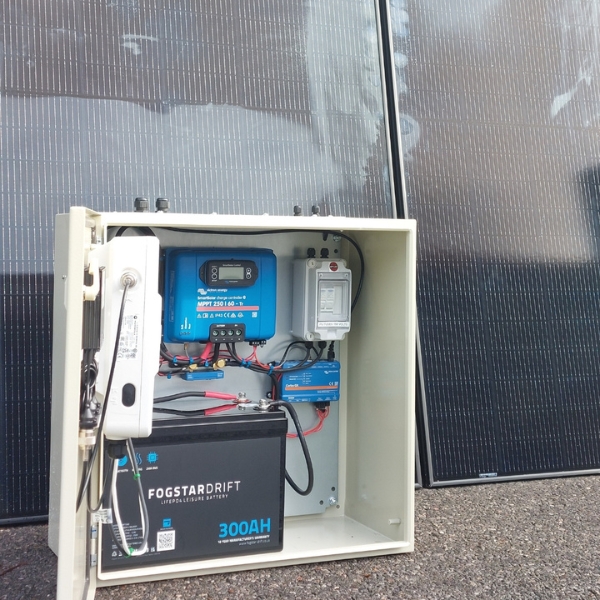
Solar panels generate electricity during the day, which is then stored in batteries. The batteries then power a radio repeater to guarantee 24/7 availability.
This means no cables, no generators and no fuel deliveries, giving you a clean and environmentally friendly solution.
2. The Radio Repeater
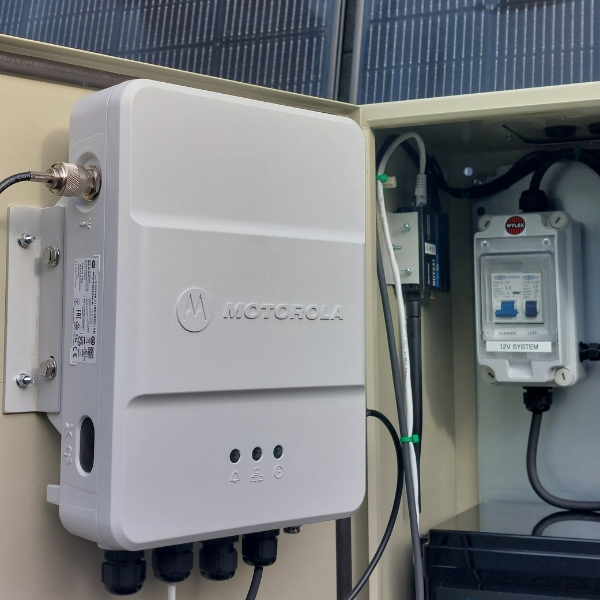
The radio repeater is like a signal booster. It acts as a bridge to connect radios that cannot talk directly with each other (known as ‘back-to-back’ communication). Installed at height, such as on a mast or container, it extends coverage into areas that were previously out of range and removes coverage blackspots.
3. System Monitoring
In addition, software called TRBOnet can be incorporated to add visibility, control, and safety features. It can show where your two-way radio users are located, sends alerts if someone presses their emergency button, and alert you if a lone worker falls.
This transforms radios from basic voice devices into a monitored safety system.
Real-World Examples
Rural Location Sports Event
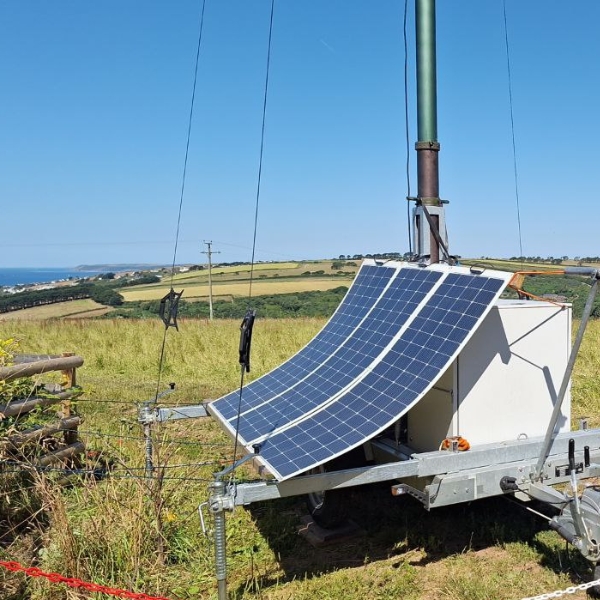
The Bantham Swimmer Hub needed a reliable communications system for an open water swimming event on the coast. Here, solar-powered repeaters were installed to provide coverage for the safety teams that were monitoring the participants.
The system allowed the event coordinators to maintain constant contact with the water safety personnel, track their positions, and respond quickly to any incidents, all without relying on grid power or mobile coverage in an exposed coastal environment.
Mass Participation Events: Silverstone and CarFest
Large events need radio coverage across multiple sprawling areas and due to the number and density of the crowds, mobile networks cannot be relied upon. Whether it’s a multi-day festival or a Grand Prix weekend, the system must work flawlessly from the start.
At CarFest, solar-powered repeaters provided coverage across the entire festival site for security, medical teams, and operations. While at Silverstone, the system supported traffic management during Grand Prix weekends, coordinating vehicle movements and emergency response.
In these environments, the solar-powered radio solution provided a quick and easy way to ‘drop in’ two-way radio comms that was independent of existing infrastructure.
Defence Site Lone Worker Safety
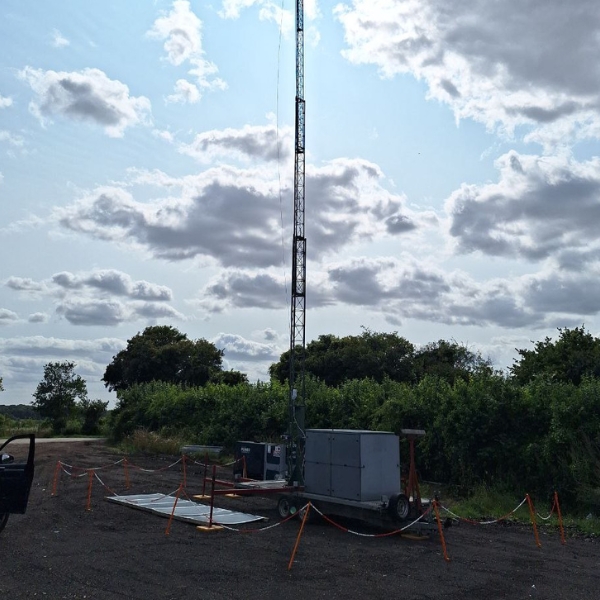
A large defence estate had isolated regions that suffered from communication blind spots. In this situation, solar-powered repeaters extended the two-way radio coverage to the whole estate. Due to the remoteness of some areas, TRBOnet was also deployed to provide safety monitoring and alerting for the teams operating in the area, which included:
- Emergency button activation with GPS location
- Man-down detection alerts
- Live workforce visibility
- Check-in monitoring and missed check-in notifications
The solar-powered two-way radio system ensures that workers operating in remote or isolated areas remain connected and visible to control teams.
How can you benefit?
A solar-powered two-way radio system:
1. Provides full-site two-way radio coverage
2. Needs no existing infrastructure, or can operate independently of it
3. Can be deployed quickly
4. Offers an eco-friendlier solution
5. Requires little or no maintenance compared to a diesel generator
If your site has off-grid areas and communication blind spots, a solar-powered two-way radio system can make a real difference to safety and day-to-day operations.
Our experience shows how these systems can provide reliable coverage where it’s needed most, with each setup tailored to the site layout and your operational requirements.