
When a major incident unfolds, mobile networks are often among the first things to fail. Power cuts, flooding, fire evacuations, and severe weather can all disrupt the infrastructure your teams normally rely on.
Two-way radios operate independently of mobile networks and do not need internet connectivity or mains power to function, which is exactly why they remain the communication tool of choice for emergency responders, facilities teams, and security personnel when conditions deteriorate.
This article explains what to consider when building two-way radios into your emergency communication plan.
Why Mobile Networks Cannot Be Your Only Option
Most organisations treat smartphones as the default communications tool, but mobile networks have a well-documented vulnerability: they become overloaded or go offline precisely when demand is highest.
During severe weather events across the UK in recent years, mobile coverage in affected areas became patchy or unavailable for extended periods.
Two-way radios avoid this dependency entirely.
What Features Matter in an Emergency
Not all two-way radios are equal when it comes to emergency use. When selecting radios for an emergency communication plan, the features that deliver real value include:
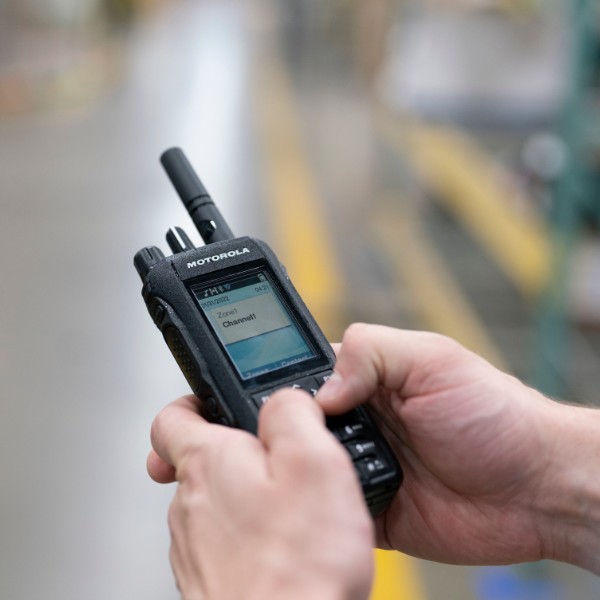
- Man-down detection. If a staff member falls or becomes incapacitated, modern digital radios such as the Motorola MOTOTRBO R7 can detect a motionless device and automatically trigger an alert to a dispatcher or supervisor. This is particularly important for lone workers or security personnel working overnight.
- GPS tracking. Knowing where your people are during an evacuation or incident is critical. GPS-enabled radios allow you to view staff locations in real time through dispatch software such as TRBOnet, without requiring staff to call in their position.
- Noise-cancelling audio. Emergency scenarios are often loud. Noise cancellation filters out background noise so voice communication remains intelligible in high-stress conditions.
- Long battery life. Most professional digital radios now offer 12 to 26 hours of battery life under typical use. This matters when an incident stretches across shifts.
- Rugged build. IP55 or higher ingress protection and MIL-STD-810 certification ensure radios continue to function in wet weather, dusty conditions, and after being dropped.
Building Two-Way Radios Into Your Plan
A radio on a shelf with a flat battery is no use in an emergency.
The most common failure point in emergency communication planning is not the hardware; it is the lack of a structured approach to maintenance, channel planning, and staff familiarity. A practical framework includes:
- Defined channels for emergencies. Separate your emergency channels from day-to-day operational ones. Staff should know exactly which channel to switch to, and it should be clearly labelled on the radio or programmed as a preset.
- Regular testing and charging routines. Batteries degrade over time. Radios designated for emergency use should be on a charging rotation and tested as part of periodic fire drills or business continuity exercises.
- Repeater coverage for large or multi-storey sites. A handheld radio without repeater support may struggle to maintain coverage across a large building, underground car park, or multi-site estate. Repeaters extend range and ensure communications reach every area of your site.
- Integration with other systems. On larger sites, it is possible to integrate your radio network with fire alarm panels, PA systems, and CCTV through platforms such as TRBOnet. This means a fire alarm trigger can automatically broadcast a voice alert across radio channels.
2CL’s installation for Hult Ashridge Executive Education is a good example. By connecting the site’s fire alarm panel to the radio network, staff on-radio receive an immediate zone-specific alert when an alarm triggers, eliminating the “blind period” where people on radio were unaware of which part of the building was affected.
Which Sectors Need This Most
Every organisation with a physical site has some version of this requirement, but the sectors where emergency radio communication planning is most critical include:
- Facilities management and corporate estates, where staff are spread across large or multi-building sites.
- Healthcare environments, where communication during a power outage or evacuation must be fast and unambiguous.
- Education, including schools and universities, where safeguarding responsibilities extend to emergency response.
- Construction and industrial sites, where lone worker protection and man-down detection are part of the statutory risk assessment.
- Events and venues, where a rapidly changing environment means communication must work even when conditions change unexpectedly.

Hire as a Short-Term Solution
For organisations that do not have a permanent radio fleet but need communication resilience for a specific period, such as a major event, a planned maintenance shutdown, or a period of heightened business risk, radio hire is a practical option.
2CL offers short-term and long-term radio hire with fully programmed handsets, accessories, and on-call support included.
Frequently Asked Questions
Do two-way radios work during a power cut?
Yes. Two-way radios operate on battery power and use radio frequencies rather than the internet or mobile phone network. Provided batteries are charged, radios will continue to function during a mains power outage.
Do I need an Ofcom licence to use two-way radios for emergency communication?
Most professional two-way radios operating on business frequencies require an Ofcom licence. Licence-free radios are available but have range limitations. For emergency use across a large site, a licensed system on a dedicated frequency is the more reliable choice.
What is the range of a two-way radio in an emergency scenario?
Range depends on the terrain, buildings, and whether repeaters are in use. In open outdoor conditions, a professional digital radio with a repeater can cover several kilometres. Within a building, the signal will penetrate multiple floors but may require repeater infrastructure to reach underground areas, stairwells, or distant wings.
What is a man-down feature and do I need it?
Man-down detection uses the radio’s accelerometer to identify when the device has been motionless in a horizontal position for a set period, indicating the user may have collapsed or been incapacitated. It then automatically transmits an alert. It is strongly recommended for lone workers, security staff, and anyone working in environments with a higher risk of personal injury.
Can two-way radios be integrated with fire alarm systems?
Yes. Through platforms such as TRBOnet, two-way radio networks can be connected to fire alarm panels so that an alarm trigger automatically broadcasts a voice message or alert tone across selected radio channels. This removes the reliance on staff hearing a physical alarm.
How long does a two-way radio battery last?
Most current professional digital radios offer between 12 and 26 hours of battery life in typical use. High-capacity batteries extend this further. For emergency resilience, a charging rotation and spare batteries should be included in your plan.
What is the difference between a digital and analogue radio for emergency use?
Digital radios offer clearer audio (particularly in noisy environments), better range at the edge of coverage, and access to data features such as GPS tracking and man-down alerts.
How many radios do I need for an emergency communication plan?
This depends on your site size, number of teams, and the incident scenarios you are planning for. A starting point is to ensure every team leader or designated fire marshal has a radio, with spares held centrally. For larger sites, a channel plan should be designed to separate teams by function or zone.
Can I hire radios specifically for emergency preparedness exercises?
Yes. 2CL offers radio hire for business continuity exercises, drills, and testing periods. This is a practical way to trial a system or meet a short-term requirement without committing to a purchase.
Make Communication Resilience Part of Your Emergency Plan
If your current emergency communication plan relies on mobile phones or a network that could go down under pressure, it is worth reviewing what would replace it.
2CL Communications has been designing and supporting radio systems for facilities managers, security teams, and site operators for over 50 years. We work with organisations including British Land, Hult Ashridge Executive Education, and Glastonbury Festival, all of whom depend on their radio systems to perform when conditions are at their most demanding.
We can advise on the right radio system, channel plan, repeater infrastructure, and accessories for your site. Get in touch today.