
Every day, thousands of people across the UK work alone. Security guards, maintenance engineers, cleaners, housing officers. If something goes wrong, there may be nobody nearby to help.
Lone worker safety technology exists to close that gap, and over the past decade it has advanced from basic check-in timers to integrated systems combining radio, GPS, and video into a single control room view.
This guide explains what modern lone worker protection looks like, why it matters for your duty of care, and how the components work together.
Your Legal Obligation
The Health and Safety at Work Act 1974 requires employers to ensure the welfare of all employees, including those working alone. The Management of Health and Safety at Work Regulations 1999 adds a requirement to carry out risk assessments for lone working activities.
In practical terms, the HSE expects employers to know where lone workers are, ensure they can raise an alarm, and maintain regular contact. All of which two-way radio with lone worker features directly supports.
Built-In Radio Safety Features
Professional digital two-way radios include dedicated lone worker features that can be configured to suit your environment.
Lone Worker Timer
If the user hasn’t interacted with the radio within a set interval, an alert sounds. No response triggers an automatic alarm to colleagues or the control room, providing continuous welfare checking without manual supervision.
Man Down Detection
A tilt sensor raises an alarm if the radio remains horizontal for a pre-set period, indicating a possible fall. An audible pre-alert gives the user a chance to cancel before the alarm fires. Read more about the Man Down feature.
Emergency Button
A dedicated button broadcasts an immediate priority distress call to all radios on the channel and, where a dispatch system is in place, alerts the control room with the worker’s location.
Location Tracking
Radios with built-in GPS transmit the worker’s location to a dispatch platform in real time, so when any alarm is triggered, response teams know exactly where to go.
Body-Worn Cameras
For lone workers at risk of confrontation, a body-worn camera adds protection a radio alone cannot provide.
Full shift recording with pre/post-record preserves footage before an alarm is even raised. Live streaming lets supervisors assess the situation remotely the moment an incident occurs, while peer-assisted recording automatically activates colleagues’ cameras on arrival. The visible presence of a camera also deters confrontation before it starts.
Integrated Lone Worker System
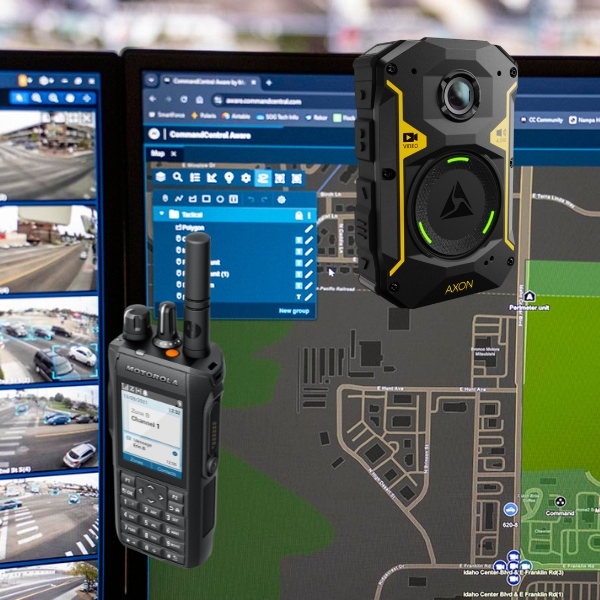
The real value of lone worker technology comes when two-way radios, body-worn cameras, and software operate as one.
TRBOnet Enterprise connects everything into a single view – live GPS mapping, automated alarm responses, geofence alerts, and instant access to body-worn camera feeds the moment an alarm is triggered. A complete solution typically combines:
- Digital radio with lone worker timer, man down detection, emergency button, and GPS
- Body-worn cameras with full-shift recording, pre/post-record, live streaming, and peer-assisted recording
- TRBOnet Enterprise for centralised alarm management, GPS mapping, and camera integration
Frequently Asked Questions
Is there a legal requirement to protect lone workers in the UK?
Yes. The Health and Safety at Work Act 1974 and the Management of Health and Safety at Work Regulations 1999 place a clear duty on employers to assess lone working risks and put appropriate measures in place.
What is the difference between lone worker and man down on a radio?
The lone worker feature triggers an alarm if the user doesn’t confirm they are safe within a set time period, while man down uses a tilt sensor to automatically raise an alarm if the radio has been stationary and horizontal, indicating a possible fall.
Do lone worker radio features work without a control room?
Yes. Alarms broadcast to all radios on the channel, so any colleague can receive them, though a dispatch platform like TRBOnet significantly improves the coordination of responses.
Can GPS tracking be used to monitor lone workers in real time?
Yes, with radios with built-in GPS, location data is transmitted to a dispatch platform at regular intervals and is immediately visible to supervisors when an alarm is triggered.
What is TRBOnet and how does it support lone worker safety?
TRBOnet Enterprise is a Motorola Solutions dispatch platform that gives a control room a live view of all radio users, automates alarm responses, and logs every lone worker event with a time and location stamp.
Do body-worn cameras integrate with two-way radios for lone worker protection?
Yes. For example, the Motorola VB400 integrates with TRBOnet, so when a lone worker alarm fires, the dispatcher can view camera footage alongside the GPS location to assess the situation immediately.
Can lone worker features be added to an existing radio fleet?
In most cases, yes. The lone worker and man down features can be enabled through programming on many digital radios, and TRBOnet can often be added to existing infrastructure without replacing hardware.
How should I set the lone worker timer interval?
A common starting point is 30 minutes for lower-risk environments and 15 minutes for higher-risk settings, though the right interval should always be determined by your lone worker risk assessment.
Talk to 2CL About Lone Worker Protection
With over 50 years’ experience, 2CL designs and supports lone worker solutions from single-site radio configuration to fully integrated dispatch and camera systems.
Contact us to discuss your requirements.