
Schools are busy, spread-out environments where staff need to communicate quickly, reliably and discreetly throughout the day.
From reception to the sports field, from the site office to the playground, the ability to reach the right person quickly can make a significant difference to both safety and day-to-day operations.
This article explains why two-way radios are well-suited to school environments, what they offer over mobile phones and other communication methods, and the specific situations where they add the most value.
Why Mobile Phones and PA Systems Fall Short in Schools
Many schools rely on a combination of mobile phones, landlines, and public address systems for staff communication. Each of these has limitations that become clear in practice.
- Mobile phones require staff to unlock a device, find a contact and wait for a call to connect. In a fast-moving situation, that delay matters. Signals can also be unreliable inside older buildings or in areas with poor network coverage. There is also the question of staff visibility: a school that enforces a no-phones policy for students can find it difficult to maintain that standard when staff are regularly seen using their own devices.
- PA systems are useful for whole-school announcements but are not suitable for targeted or sensitive communication. Broadcasting an alert to the whole school during a safeguarding incident or lockdown scenario can cause confusion or panic rather than the calm, coordinated response that staff need to deliver.
Two-way radios address both limitations.
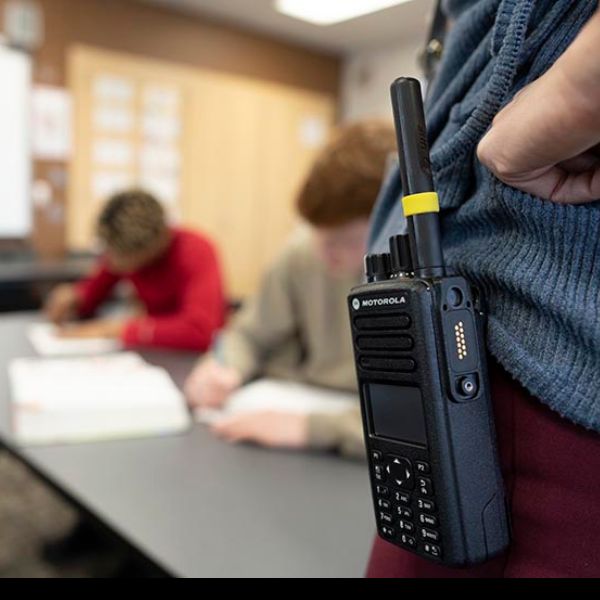
Push-to-talk communication connects staff instantly with no dialling, no waiting and no reliance on mobile network coverage. Channels can be set up to keep different teams separate, so site staff, senior leadership and pastoral teams can each communicate within their own group, or across groups when needed.
Safety and Emergency Response
Clear communication is key to managing emergencies. Whether the situation is a fire alarm, a medical incident, or a more serious threat requiring a lockdown, staff need to be able to reach each other instantly.
Two-way radios operate on dedicated frequencies that are not affected by internet outages, power cuts or mobile network congestion. In an evacuation, staff can confirm areas are clear in real time. During a lockdown, senior leaders can communicate with staff across the site on a private channel without broadcasting sensitive information publicly.
The Terrorism (Protection of Premises) Act 2025, known as Martyn’s Law, introduces legal duties for publicly accessible premises expecting 200 or more people, including many secondary schools, colleges and larger primaries during events. The Act requires organisations to have documented evacuation, invacuation and lockdown procedures in place, with reliable communication built into those plans. Two-way radios are a practical and widely used way to meet that requirement.
Even outside formal emergency procedures, radios support faster response to everyday incidents: a pupil who is unwell, a fight in the playground, an unauthorised visitor at the gate. Staff can report and respond without leaving their post or losing sight of students in their care.
Day-to-Day School Operations
The benefits of two-way radios in schools extend well beyond emergency response. In day-to-day operations, they help staff across different roles stay coordinated throughout the day.
Site and facilities teams use radios to manage maintenance tasks, respond to issues quickly and avoid students entering areas that are unsafe or undergoing repair. Reception staff can confirm room availability, direct visitors or alert colleagues to arrivals without leaving the front desk. During break times, dinner supervision and end-of-day collection, radios allow staff to monitor multiple areas simultaneously and call for support when needed.
Events such as sports days, open evenings and school trips also benefit significantly. Coordinating staff across a large site or an off-site venue is straightforward with radios, where the same task over mobile phones requires multiple separate calls. For school trips in particular, radios can keep group leaders in contact even where mobile signal is limited.
For multi-academy trusts and schools with split-site campuses, radios can be configured to cover both sites on the same system, allowing staff to communicate across locations without switching between devices or platforms.
Licensed Radios vs Licence-Free Walkie-Talkies
Many schools start out with licence-free walkie-talkies, often purchased inexpensively for a specific purpose such as a school trip or sports day. These devices work on shared public frequencies, which means other users in the area may be transmitting on the same channel. Range is also limited, typically to a few hundred metres in built-up environments, and features are basic.
Licensed radios operate on a frequency assigned exclusively to the school by Ofcom, which removes the risk of interference from other users. Digital licensed radios offer encrypted communication, longer range, clearer audio and a range of programmable features such as individual and group calling, PTT IDs and emergency buttons. They are better suited to the demands of a busy school site, where communication needs to be reliable and private.
An Ofcom radio licence costs a modest annual fee and is straightforward to obtain and manage. Many schools that have made the switch from licence-free devices to licensed digital radios report a significant improvement in clarity, reliability and overall confidence in the system.
Choosing Two-way Radios for a School
School environments have some specific requirements that are worth considering when selecting a radio system.
- Durability: radios will be used by a range of staff and need to withstand everyday handling. An IP54 or IP55 rating provides protection against dust and light water exposure.
- Ease of use: not all staff are technical. A simple interface with clearly labelled buttons and a familiar layout means less training time and fewer errors.
- Battery life: a full working day is typically 8 to 10 hours. Most quality radios are rated for 12 hours or more, which provides sufficient headroom.
- Size and weight: a lighter, more compact radio is easier for staff to carry throughout the day without discomfort.
- Channel capacity: a school with separate teams for site management, pastoral support and senior leadership will benefit from a radio with enough programmable channels to keep communications organised.
- Lone worker protection: some radios include man-down alerts or automatic check-in timers, which can be valuable for staff working alone on site, particularly outside school hours. Read more about lone worker technology
Both digital and analogue options exist at entry-level price points, and the right choice will depend on the size of the site, the number of users and any specific safety requirements.
Frequently Asked Questions
Do schools need an Ofcom licence to use two-way radios?
Not for all types of radio. Licence-free radios, which operate on shared public frequencies, can be used without a licence. However, for dedicated frequencies with better privacy, range and audio quality, schools need an Ofcom radio licence. Licences are issued per site and are available for a modest annual fee. A radio supplier or specialist can handle the application on a school’s behalf.
What is the difference between analogue and digital radios for schools?
Analogue radios are simpler and often less expensive, but have fewer features and offer no encryption. Digital radios provide clearer audio, encrypted communication, longer range and additional functions such as text messaging, GPS tracking and emergency alerts. For most secondary schools and larger sites, digital radios are the recommended choice. Smaller primaries may find an analogue system sufficient for their needs.
Can two-way radios be used across different buildings on a school campus?
Yes. A licensed digital radio system with a repeater can extend coverage across multiple buildings and outdoor areas. For schools on split sites or with significant distance between facilities, a repeater installed at a suitable location on site will maintain consistent coverage. A supplier can carry out a site survey to confirm coverage before any equipment is purchased.
Are two-way radios useful for managing a school lockdown?
Yes. During a lockdown, two-way radios allow senior staff to communicate with colleagues across the site on a private channel, without alerting students or broadcasting sensitive information through the PA system. Staff can confirm their location, receive instructions and report updates in real time. For schools implementing procedures under Martyn’s Law, reliable radio communication is an important part of a workable emergency plan.
Can two-way radios be used on school trips?
Yes. Radios are well suited to school trips where mobile signal may be limited or absent. Group leaders can stay in contact with each other and with a designated base contact. For smaller groups, licence-free devices may be adequate. For larger or more complex trips, a licensed digital radio with greater range will provide more reliable coverage.
How many radios does a school typically need?
This depends on the size of the site and the number of staff roles that require instant communication. A small primary school might operate effectively with four to six radios covering reception, the site team and a member of senior leadership. A large secondary school or college will typically require more handsets to cover pastoral, security, site, catering and management functions. A supplier can advise on the appropriate number following a site assessment.
What is Martyn’s Law and does it apply to schools?
Martyn’s Law, formally the Terrorism (Protection of Premises) Act 2025, requires publicly accessible premises expecting 200 or more people to have documented procedures for evacuation, invacuation and lockdown in place. Many secondary schools, colleges and larger primaries will fall within scope, particularly during events or open evenings. Schools in scope will need to demonstrate that their emergency communication plan is functional and that staff are trained to use it.
Is it cheaper to buy or hire two-way radios for a school?
For long-term, everyday use, purchasing radios is generally the more cost-effective option. Hiring is a practical choice for schools that need additional radios for a specific period, such as during sports fixtures, open evenings or an inspection. Some suppliers offer long-term hire arrangements that include maintenance and support, which can suit schools that prefer a predictable annual cost over a capital outlay.
Talk to 2CL About Radios for Your School
If you are looking to improve communication and safety at your school, 2CL Communications can help. With over 50 years of experience in the education sector, 2CL designs and supports radio systems for schools, academies, multi-academy trusts, and further education colleges across the UK.
2CL can advise on the right radios for your site, whether you need a handful of handsets for a small primary school or a fully programmed digital system for a large secondary or FE college. Ofcom licence management, ongoing maintenance, and long-term hire options are all available as part of a managed service.