
POC stands for Push to Talk Over Cellular. It combines the simplicity of a two-way radio with the coverage of a mobile phone network, letting teams communicate instantly at the push of a button across any distance where there is cellular or Wi-Fi signal.
This article explains what POC radio is, how it works, and whether it is the right fit for your operations.
What Is a POC Radio?
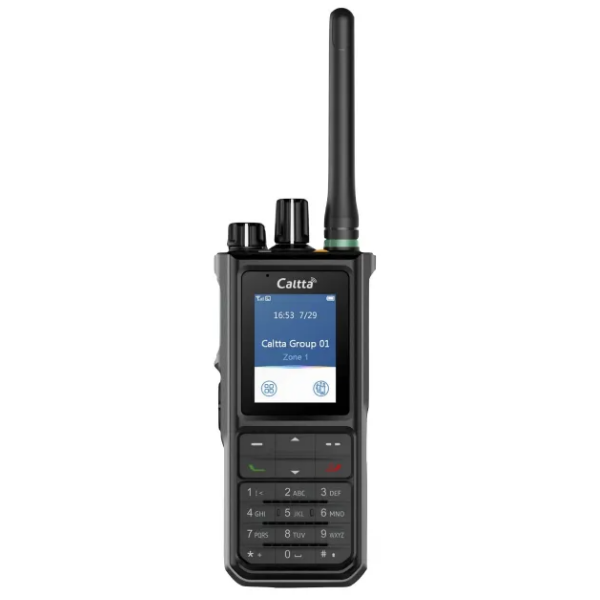
A POC radio is a device that looks and operates like a traditional two-way radio, but instead of transmitting over dedicated radio frequencies, it sends voice over a data network. As long as there is a cellular network (e.g. 4G, 5G) or Wi-Fi signal, users can communicate instantly, one to one or one to many, at the press of a button.
This is fundamentally different from a standard mobile phone call. There is no dialling, no waiting for someone to answer, and no need to call people one at a time. POC works just like a radio: press to speak, release to listen. The difference is that the signal travels over the same cellular infrastructure that powers your mobile phone, which means coverage is nationwide rather than limited to the range of a local radio system.
POC devices are sometimes referred to as LTE radios, 4G radios, or PoC radios. These terms all refer to the same underlying technology.
How Does It Work?
A POC radio contains a SIM card, just like a smartphone. When a user presses the push-to-talk button, the device transmits audio over the data network to one person, a group, or an entire fleet of devices simultaneously. The experience from the user’s perspective is identical to a conventional radio: instant, one-button communication with no delays.
As well as voice, POC platforms typically support GPS location tracking, group messaging, emergency calling, lone worker monitoring, and in some cases image and document sharing. These features are accessed through a user licence associated with the device.

What Do You Need to Get Started?
There are three things required to operate a POC radio:
- A POC device. This is the radio itself. Dedicated POC handsets are built to the same durability standards as traditional two-way radios, with ruggedised housings, long battery life, and a physical push-to-talk button. Some organisations also run PTT apps on existing smartphones or tablets, which removes the need for additional hardware.
- A SIM card. Because POC operates over data networks, each device requires a SIM to connect. Multi-network SIMs are available that automatically connect to the strongest available signal across multiple operators, reducing the risk of coverage gaps.
- A user licence. A software licence is associated with each device on the network. This licence enables the full feature set, including group calling, emergency call functionality, GPS tracking, and voice recording. Without an active licence, the device cannot connect to the network.
No Ofcom radio licence is required for POC devices. Because they operate over data networks rather than radio frequencies, they fall outside the scope of Ofcom spectrum licensing.
What Is the Range?
POC radios have no fixed range. They work wherever there is cellular or Wi-Fi coverage, which means nationwide across the UK and in many cases internationally. For teams spread across multiple sites or large geographies, this removes the distance limitations of a traditional radio system entirely.
Which Industries Use POC Radio?
POC radio is used across a broad range of sectors where teams work beyond the reach of a single radio site or need to coordinate across large areas:
- Logistics and transport — drivers and fleet managers can stay in contact across routes and depot locations without relying on mobile calls.
- Facilities management — contractors and mobile engineers covering multiple sites can be reached and coordinated on a single system.
- Construction — site teams working across large or spread-out projects can communicate without investing in repeater infrastructure.
- Security and lone worker — GPS tracking and emergency calling features make POC a practical choice for staff working alone or in remote locations.
- Retail and hospitality — for organisations with multiple branches or large sites, POC removes the need for separate radio systems at each location.

POC Radio vs Traditional Two-Way Radio
POC and traditional two-way radio are complementary rather than competing technologies.
Traditional radios are the stronger choice where mobile network coverage is poor or unavailable, such as in underground facilities or reinforced buildings, and where reliability is paramount. POC is the better fit where distance is the primary challenge, deployment speed matters, or teams work across multiple locations.
For some organisations, a hybrid approach makes sense. Traditional two-way radios on site, POC for remote or mobile workers. Gateway devices can bridge the two systems so that users on both platforms communicate with each other seamlessly.
Frequently Asked Questions
What does POC stand for?
POC stands for Push to Talk Over Cellular, describing two-way radio communication that travels over mobile data networks rather than dedicated radio frequencies.
Does a POC radio need a SIM card?
Yes, each device requires a SIM card to connect to the data network; multi-network SIMs that automatically select the strongest available signal are available to reduce coverage gaps.
Do I need an Ofcom licence for a POC radio?
No, POC radios operate over data networks rather than radio spectrum, so no Ofcom licence is required.
How far can a POC radio transmit?
POC radios work wherever there is cellular or Wi-Fi coverage, which in practice means nationwide across the UK and in many cases internationally.
What is a user licence on a POC radio?
A user licence activates the device on the network and enables features such as group calling, emergency call, GPS tracking, and voice recording.
Can I use a smartphone as a POC radio?
Yes, POC apps can turn an existing smartphone or tablet into a POC device, though dedicated handsets remain the better choice where durability and a physical PTT button matter.
Can POC and traditional two-way radios work together?
Yes, gateway devices can bridge a POC network and a traditional radio system so that users on both platforms communicate with each other seamlessly.
What features does a POC radio offer beyond voice calls?
POC platforms typically support GPS location tracking, group messaging, emergency calling, lone worker monitoring, and in some cases image and document sharing.
Is a POC radio suitable for lone workers?
Yes, the combination of GPS tracking, emergency calling, and nationwide coverage makes POC well suited to staff working remotely or across dispersed locations.
Find Out If POC Radio Is Right for Your Team
Whether you are looking to extend coverage for mobile workers, reduce infrastructure costs, or connect teams across multiple locations, 2CL Communications can advise on the right solution for your organisation.